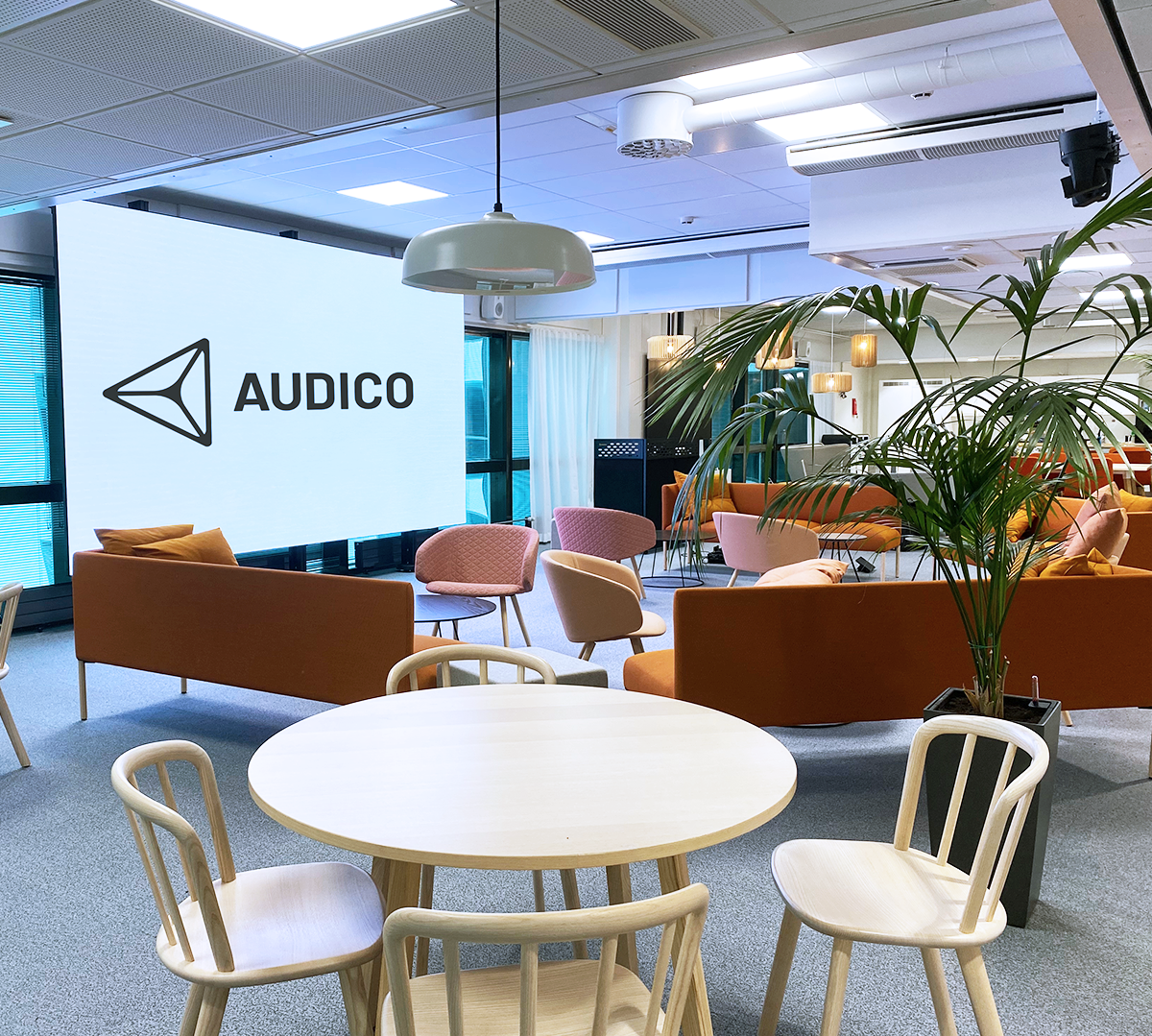
Working cafe — the modern event space for today’s organisations
Many companies have a dedicated space for larger gatherings: training sessions, internal events, company-wide meetings, or external occasions like client days and partner events. Often it’s a traditional auditorium or a large meeting room, designed for one purpose — bringing a big group of people together in one place.
Working cafe — also known as a multifunctional space, hybrid venue, information hub, or town hall space — is a different approach to the same need. It’s an event space designed from the ground up to be flexible, serving not one purpose but many.
What does a working cafe mean in practice?
A working cafe is a space that works across different situations without needing to be reconfigured each time. In the morning it can serve as an informal working area for collaboration. In the afternoon, the whole company gathers for a company-wide meeting. In the evening, it becomes the stage for a client event — streamed live to an online audience.
What makes it distinctive is not just flexibility, but that it performs equally well across very different communication situations. An internal training session with a hundred participants joining hybrid. A results presentation where leadership wants to hear from the team, not just address them. A client event streamed simultaneously online. A working cafe is designed to handle all of these — not as a compromise, but by design.
From one-way communication to real interaction
A traditional auditorium is built for one-way communication: a speaker at the front, an audience in rows. It still serves a purpose, but it falls short of what modern organisations need from their spaces.
In today’s organisations, communication rarely works that way. Some participants join remotely. Training sessions call for questions and discussion. Leadership wants to hear from people, not just speak at them. Events are streamed directly online.
A working cafe is built for this reality. It supports both structured presentations and genuine two-way interaction, working just as well for those in the room as for those joining remotely.
Sound is where most spaces fall short
If there is one element that is consistently underestimated in working cafe design, it is sound.
Traditional audio systems amplify the speaker’s voice to the audience. They work well for presentations, but they don’t support natural conversation where multiple people want to speak and be heard. A remote participant hears the presenter but often misses audience reactions and questions.
A modern voice lift system solves this. It picks up contributions from across the room and distributes them clearly to everyone, both those present and those joining remotely, without handheld microphones or manual audio management. The result is a space where interaction feels natural, regardless of where each participant is.
What goes into a working cafe?
A working cafe is made up of several elements designed to work together. A typical setup includes LED or LCD displays or projection, an audio and microphone system with cameras, flexible lighting, acoustic treatment, broadcast and streaming capability, and a control system.
Acoustics is the element most often given too little attention. It should be considered before a single piece of equipment is chosen, because poor acoustics will undermine everything else, no matter how good the technology is.
An equally important part of the whole is ease of use. A working cafe should be usable by anyone, without a dedicated operator or technical expertise. At its simplest, that means joining a meeting and sharing content with remote participants directly from a laptop via Teams. For larger productions — a streamed event for hundreds of people — the system is programmed so that operating it remains straightforward. Good technology doesn’t show itself through complexity. It shows in the fact that things simply work.
When does a working cafe make sense?
A working cafe suits organisations with a regular need to bring larger groups together, internally or externally, in person or hybrid.
For organisations that repeatedly rely on external AV production services or hired venues for events and company meetings, the economics of a permanent in-house solution start to look different. And a space that is in active daily use across multiple purposes delivers significantly more value than one that is opened a few times a year.
Audico as your partner
A working cafe, done well, means the organisation can focus on communicating — not on managing technology. With 65 years of experience in AV and a track record across hundreds of demanding projects, Audico designs and delivers working cafe solutions that perform in real-world use, day after day. Our local team, proactive monitoring, and predictable costs ensure that communication stays at the centre — and the space stays easy to use.